
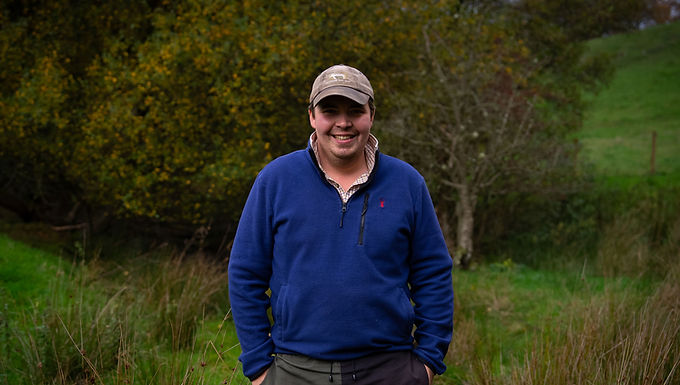
Ben Cooke is from Ratlinghope in South Shropshire, farming between the Long Mynd and the Stiperstones. A graduate of Harper Adams University, where he studied agriculture, Ben has returned home to help shape the future of the family farm. Raised on the farm, he developed an early connection to the land and a respect for the realities of livestock farming. While proud of the farm’s traditional roots, shaped through decades of production-focused agriculture, Ben is focused on building a resilient, forward-thinking business. He is passionate about protecting the environment that underpins the farm’s success, working towards a system that produces high-quality produce primarily from homegrown grass while reducing reliance on costly artificial fertilisers and feed. Ben is gradually introducing new approaches, including rotational grazing to improve soil health, encourage wildflowers and increase biodiversity. He sees environmental stewardship not as a replacement for food production, but as a way to strengthen it — improving carbon sequestration, water retention and long-term profitability. As a director of the Upper Onny CIC, he is also closely involved in coordinating collaborative, catchment-scale environmental work across the local farming community.
Some additional farm info
Farm size 300 acres
Between 120 and 180 cattle each year
Lamb around 120 sheep
Sheep breeds are Aberfield SR and Zwartbles
Cattle are Cross bred dairy heifers

Our Projects
Watercourse Protection and Wetland Creation on the Darnford and Bilbatch Brooks
This landscape-scale project has restored and enhanced wetland habitat along the Darnford and Bilbatch Brooks, helping to improve water quality, support wildlife and reduce downstream flood risk.
Approximately 1.5km of watercourse has been fenced to exclude livestock, protecting sensitive riverbanks and adjacent wetlands from erosion and poaching. Stock-proof fencing has also been erected to safeguard an Environment Agency–funded wetland enhancement scheme on the Darnford Brook, delivered through the Water Environment Investment Fund, designed to slow the flow of water and create improved conditions for wetland birds and invertebrates.
Along the Bilbatch Brook, which borders the Long Mynd Site of Special Scientific Interest, fencing has helped protect and restore over one hectare of wetland habitat. The longer-term ambition is to return the watercourse to a more natural state by reconnecting it with its floodplain and raising the local water table. This approach moves away from a single, modified channel and towards a more dynamic system that benefits both wildlife and water management.
The project has delivered significant benefits for species such as curlew and lapwing, while also improving water quality and contributing to natural flood management.
To support these changes, two solar-powered water pump systems have been installed, along with water storage tanks, pipework and mobile troughs. These provide reliable drinking water for livestock and enable the introduction of a rotational grazing system across approximately 50 hectares of upland grassland and hill ground. A water audit was also undertaken to inform sustainable water use across the farm.
In addition to the environmental improvements, the project has enhanced public access. Supported by Defra’s Access for All fund, accessibility improvements have been made along a section of the Shropshire Way long-distance walking route. An interpretation panel explains the importance of wetland restoration and highlights the work undertaken to protect and enhance this special landscape.
Together, these measures demonstrate how collaborative investment can deliver benefits for farming, wildlife, water management and public access across the Shropshire Hills.